Dynamic power orchestration dramatically increases tokens per watt

High resolution, low-latency visibility

Dependable actionable control

Safe fallback guardbands
Utilidata has used AI to optimize power flow for over a decade with proven results of increasing capacity utilization.
Stranded capacity is stranded revenue
Power availability from the grid is now the biggest constraint for AI growth. Today, data centers manage power by the second. This is too slow to keep pace with the dynamic load swings of AI workloads, forcing operators to oversize infrastructure leaving stranded capacity. We're changing that.
Karman puts every watt to work
Karman orchestrates power by the millisecond with microsecond visibility to unlock underutilized capacity for revenue-generating workloads, boosting compute output with the same provisioned power from the grid.
Increased output
50% more compute output with the same provisioned power
Accelerated capacity
Bring capacity online faster
Watts, maximized
Generate more tokens per provisioned watt
Frequently asked questions
What is Karman?
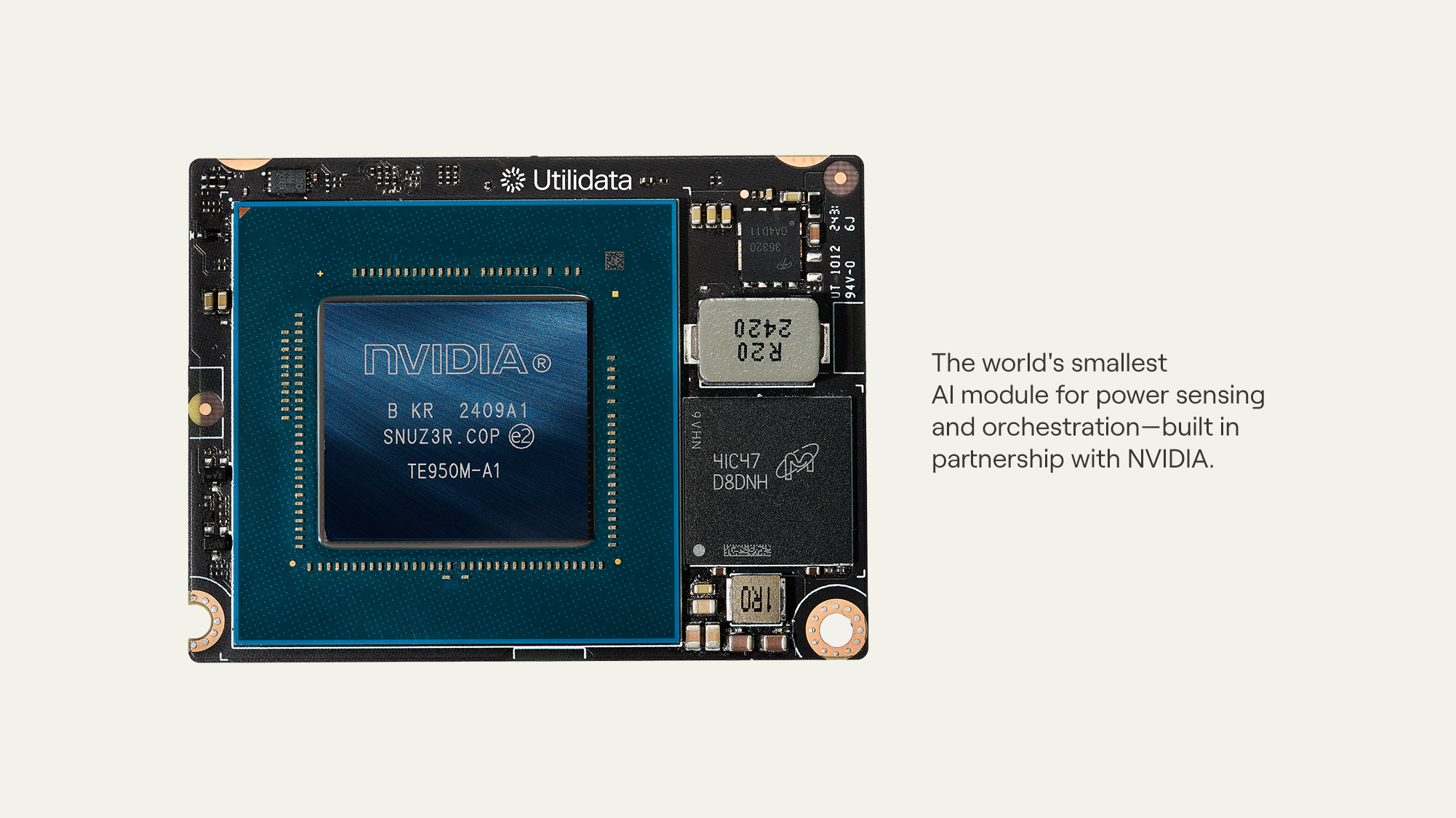
Karman is a dynamic power orchestration platform from Utilidata, built on a custom NVIDIA module embedded in data center power infrastructure. It pairs high-resolution metrology with local AI processing to boost compute capacity by up to 50% from the same provisioned power.*
*Note: 50% is an estimation and results will vary by customer environment based on power infrastructure and server configuration.
How does Karman boost data center compute capacity by up to 50%?
Karman is deployed locally at the rack to measure power and issue control signals to the compute, enabling the speed required to match power availability to AI compute demand. This converts a static buffer into dynamically orchestrated capacity, delivering incremental compute capacity from the same power infrastructure.
How is Karman deployed in a data center?
Karman pairs a software orchestration layer with metrology and computation embedded in the rack hardware. Karman can be deployed in standalone hardware or within common power infrastructure such as power cabling, tap-off boxes, power shelves, and rack PDUs.
What’s the difference between Karman and software-only power tools?
Karman is embedded at the rack, allowing it to see virtually every detail of the waveform, process telemetry data, and send control signals to servers in less than 2 milliseconds. This allows Karman to harness every available watt from the powertrain and allocate it to AI compute. Because AI workloads fluctuate so sharply, second-scale tools that rely on remote data have limited impact.
How fast is Karman, and how is its response time measured?
Karman samples power, processes the data, and issues control signals to the IT compute in less than 2 milliseconds. The total response time includes the server reacting to the control signal: metrology sampling, local processing on the Karman module (under 1 ms), and the command to the servers. This end-to-end response time will vary by server but is estimated to be between 20-100 milliseconds.
How does Karman prevent exceeding the power budget or damaging equipment?
Karman continuously measures voltage and current and enforces power limits locally at each rack. If a rack approaches its power envelope, Karman adjusts GPU power caps through NVIDIA NVML in under 20 ms — fast enough to prevent overloads before traditional protection equipment such as breakers, fuses, or UPS would trip.
What data does Karman record in each sample?
Karman samples current and voltage waveforms directly at the rack and processes them locally into configurable power statistics — real and reactive power, RMS voltage and current, and power factor. Both raw waveforms and processed data are available to on-device analytics and can stream to customer observability systems.
What metrics does Karman make available?
Karman exposes real-time power metrics at every level of the data center — per rack, per phase, and at configurable aggregation levels. Metrics include real and reactive power, RMS voltage and current, power factor, provisioned power utilization, unused capacity, and RMS and max excess power. They integrate with standard observability tools, including Prometheus, Grafana, Kafka, and Databricks.
Can I use Karman for power oversubscription?
Yes. Dynamic oversubscription is one of Karman’s core capabilities. Its millisecond control speed lets data centers oversubscribe power dynamically, rather than relying on static power caps that leave excess capacity stranded.
Will Karman reduce power fluctuations from the data center to the grid?
Yes. Karman caps the sharp power swings characteristic of AI workloads before they reach the utility interface, and can use its fast response time to control energy storage. The result is a steadier net draw on the grid.
Can Karman scale across multiple data centers?
Karman manages each data center individually; fleet-wide load balancing stays in the operator’s stack. Operators can feed Karman metrics, such as provisioned power utilization, into their workload routing layer to inform load-balancing decisions.
What happens to my data center if Karman fails?
Karman operates independently of power infrastructure and IT compute, so a failure poses no risk of data center interruption. Each Karman Control device has redundant compute hardware to make failure unlikely. If a node fails, the rack it manages keeps running within its reduced power envelope. Because Karman is a distributed system, only that rack is affected, while the rest of the data center remains oversubscribed.
What security measures are in place for Karman?
Karman is SOC 2 compliant. Security features include Secure Boot, disk encryption, and signed over-the-air (OTA) updates. The SoC is fused during initial provisioning, before the device leaves the manufacturing facility.
Does Karman run AI/ML in firmware?
Karman runs its AI and machine learning algorithms on the Karman platform stack, built on a custom Linux distribution. They operate locally on live current, voltage, and power data streams.